
In many institutions, the level of security no longer depends on whether the building has cameras, alarms, and technical systems. That is usually already in place. The real question is different: can the security team understand what is actually happening at the right moment — and what requires a response first?
This is precisely where a PSIM system comes in. Such a platform does not replace every device in the building. It connects them into a single management environment, organises information, and helps people make better decisions under time pressure. One example of such a solution is GEMOS — a PSIM platform that integrates fire detection (SSP), CCTV, intrusion detection (SSWiN), voice alarm (DSO), BMS, and fire-protection automation — reducing response times and limiting the risk of human error.
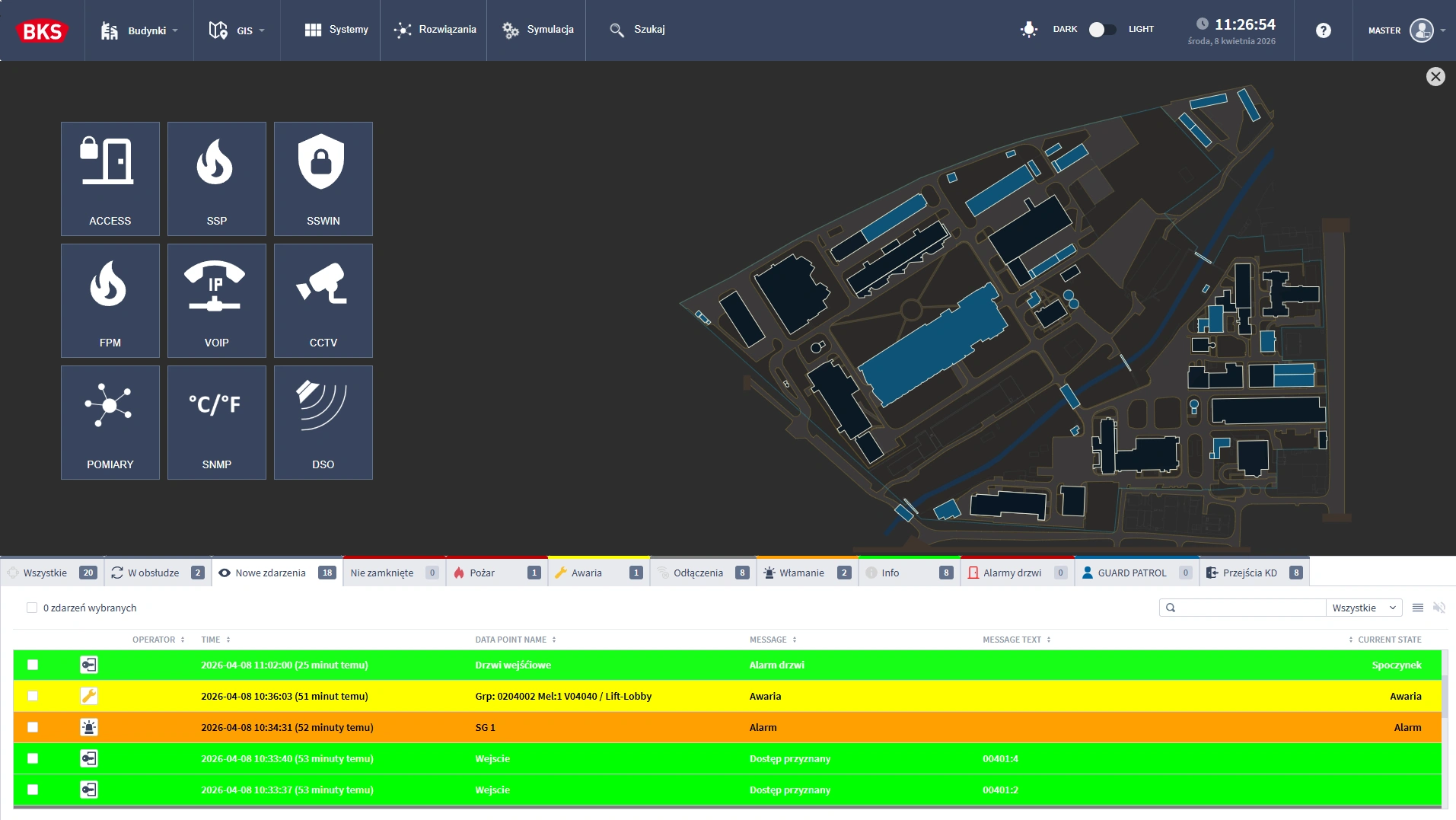
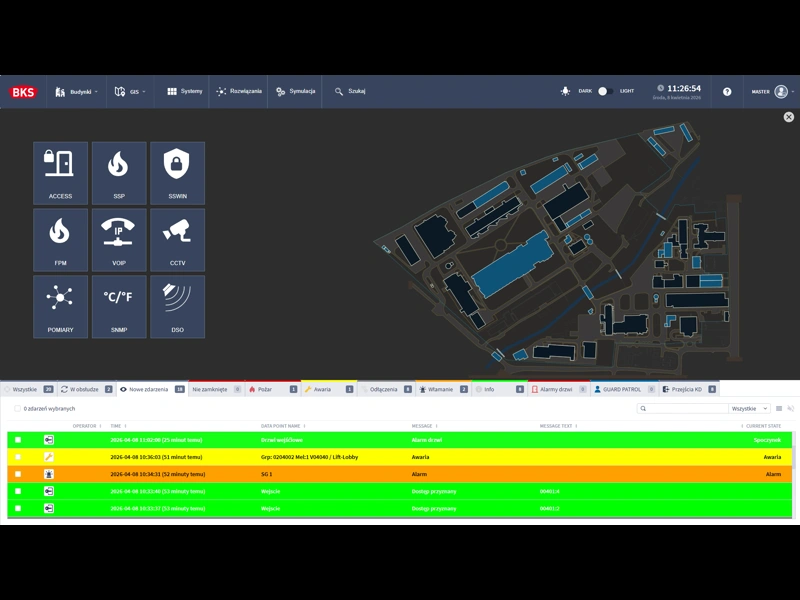
GEMOS interface — subsystem icons, facility map, and the event stack with colour-coded priority levels.
The problem is not a lack of data — it is too much of it
In the daily work of a monitoring centre, the biggest adversary is not necessarily a failure or an alarm. Very often it is information overload. Messages from various systems flow to the operator, and some of them only appear to be operationally significant. In practice, this means cognitive overload that weakens response quality.
This is not a theoretical problem. In practice, the topic of operator overload, the security paradox, and the need for a coherent working environment — rather than adding yet another separate tool — comes up regularly.
The event stack in GEMOS is the place where all signals from integrated systems arrive, yet the operator does not need to see everything. The system detects what truly matters, assigns it a priority, and displays it in the correct order. In large deployments, it is not uncommon for 50 events per second.
What is the event stack in GEMOS
The event stack is not just another message list. It is a mechanism for organising the operator’s attention.
Its purpose is to separate important information from what can remain in the background. Events of the highest significance appear at the top. Less critical ones are pushed lower. This means the security officer does not have to analyse all system traffic independently. They receive an ordered picture of the situation and can decide more quickly what requires immediate action and what merely needs to be noted.
This is precisely what distinguishes a professional environment from simple data collection. A good system does not display everything with equal weight — it helps set the right priorities.
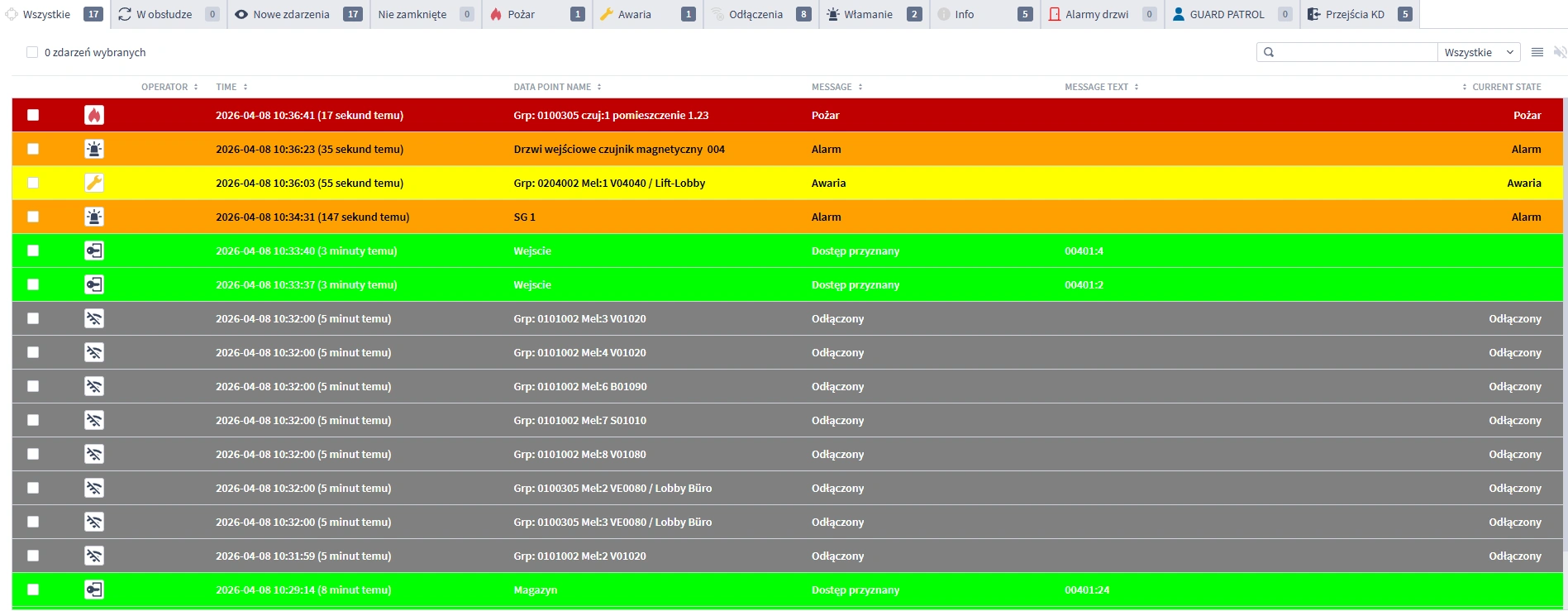
Event stack with priority hierarchy — critical events (red) displayed at the top, informational events (green) below.
Why this matters for those responsible for security
For a person managing security in an institution, the key question is: can the security team maintain control when time pressure mounts, multiple events occur simultaneously, and rapid risk assessment is needed?
This is where the value of the GEMOS platform becomes clear. It serves as a single management layer for multiple security and building-technology systems, with an emphasis on work ergonomics, vendor neutrality, and reducing operator error. GEMOS can work with over 350 interfaces and does not require replacing all existing systems to build a unified management logic.
For institutions, this translates into a very specific benefit: security stops being a collection of separate technologies and begins to function as a single organism.
How GEMOS helps security teams manage a crisis
In a crisis, the winner is not the one with the most data. It is the one who identifies the critical event fastest, locates it accurately, and triggers the right response.
The event stack supports this process on several levels:
- it organises information,
- it shortens the operator’s orientation time,
- it reduces the risk that an important event will be buried under less significant messages,
- it strengthens the predictability of the security team’s actions.
It is also worth noting that the operator is notified of events not only visually but also audibly. In a real working environment, what counts is not just the presence of information, but the way it captures a person’s attention at the right moment.
When the facility is complex, good visualisation and event hierarchy become critical
In a simple building, many things can be handled by the operator’s experience alone. In large, multi-storey, or distributed facilities, that model stops working. Security then depends on whether the system guides the person through the situation in a clear manner.
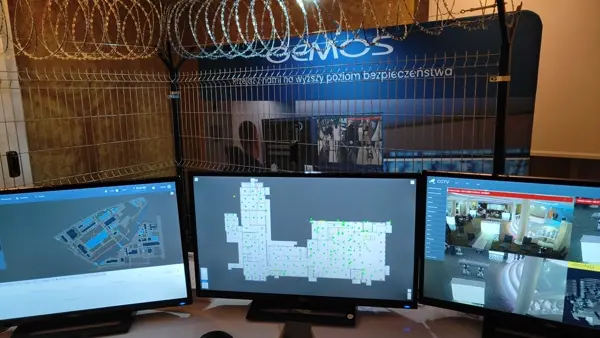
This is well illustrated by examples of GEMOS deployments across different facility types. In high-rise buildings, quick floor-by-floor navigation, tenant identification, and lift integration are essential. At railway stations and airports, evacuation plans showing not only detectors but also hydrants, AEDs, and first-aid kits play a critical role. Meanwhile, intrusion-detection visualisation shows how the operator, instead of a plain text list, sees alarms in a spatial context and can verify them more quickly.
All of this leads to one conclusion: access to data alone is not enough. What is also needed is a logic of presentation and a proper event hierarchy. Without it, even a technically advanced facility may perform worse than it should.
GEMOS is not just another screen — it is a tool that structures decisions
Many security systems look impressive at the demonstration stage, but in daily use they burden the operator more than they help. This is why those responsible for security should look not just at the feature list, but above all at whether the tool simplifies the security team’s work.
In this sense, GEMOS should be evaluated not by the number of screens, but by its operational effect:
- does the operator understand the situation faster,
- can they see priorities,
- is it easier to maintain control,
- do they act more calmly and confidently during a crisis.
If the answer to these questions is “yes”, then we are talking not about a simple integration, but about a real improvement in the facility’s security level.
Summary
The event stack does not operate in a vacuum. Its effectiveness depends on how broadly and how sensibly the security environment is integrated. The more data from different systems flows into a single management layer, the greater the value delivered by good filtering, prioritisation, and clear presentation.
If you are responsible for security in an institution, do not only ask how many systems can be connected. Also ask how the operator will work with incoming information when the situation becomes truly demanding. In a well-deployed GEMOS environment, the event stack is not an add-on to visualisation — it is one of the mechanisms that help security teams manage a crisis, structure their response, and maintain control where the stakes are the safety of people, infrastructure, and the continuity of institutional operations.
The topic of integration is explored further in Is it too late to integrate security systems? and Why security quietly becomes complicated in many facilities.