
Marketing materials for solutions aimed at modern facilities often mention SCADA, BMS and PSIM. All of them relate to supervision, visualisation, alarms, integration and operator work, yet they are intended for different tasks.
At first glance each of them may look similar. Each presents data, messages, alarms, maps, diagrams and device states. What decides their purpose, however, is the type of processes handled, the way they communicate with devices and the role of the operator.
What is a SCADA system and what is it for?
SCADA (Supervisory Control And Data Acquisition) is used to supervise a technological process that has been planned in advance. It has a defined course, a sequence of events, operating parameters, permissible deviations and defined responses. Technological processes require real-time control, in which transmission speed is critically important.
SCADA answers, above all, the question of whether the process is running in line with the adopted parameters.
Solutions of this class are used, among others, in:
- industry,
- power generation and district heating,
- water utilities,
- process installations,
- infrastructure automation.
SCADA communicates mainly with PLC controllers, measurement devices and actuators such as pumps, valves and drives.
The operator monitors temperature, pressure, flow, medium level, device states, trends and process alarms. Depending on their permissions, they can also change setpoints, run manual control actions and restore the process to the required parameters.
A typical operating cycle covers measurement, visualisation, assessment of the process state, execution of control actions and verification of their effects.
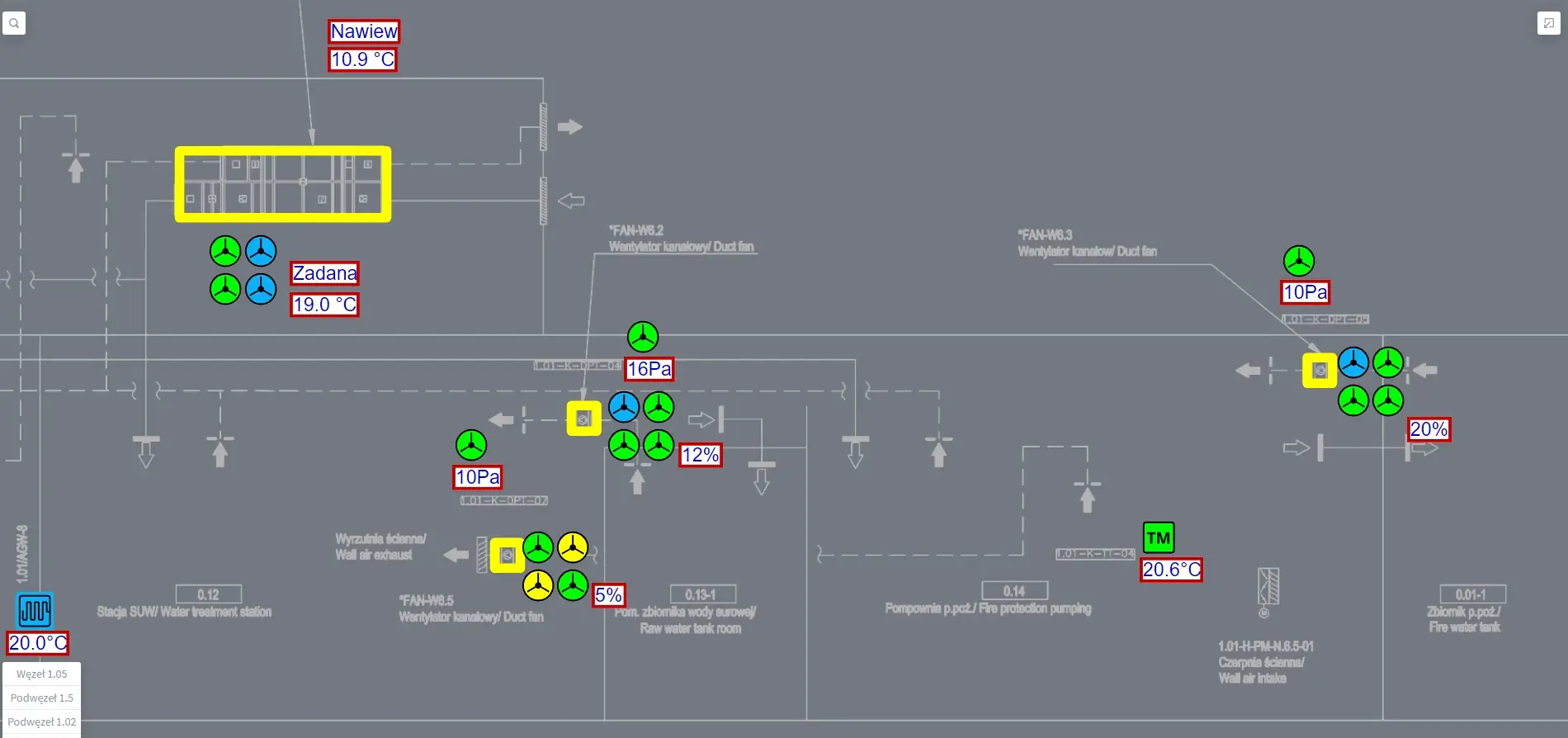
Figure 1. An example SCADA visualisation built on the GEMOS platform. The operator supervises the parameters of the technological process, device states and deviations from the adopted values.
What is a BMS and which installations does it supervise?
BMS (Building Management System) is a special case of SCADA, intended to integrate heating installations, heating, ventilation and air conditioning (HVAC for short), utility consumption, lighting and power supply within a building.
What is a PSIM system and how does it support security event handling?
A PSIM system is used in the area of facility protection. Its task is to communicate with the security systems installed in a given facility.
Within a single facility, the following may occur, among others:
- a fire alarm,
- an attempt to enter a restricted zone,
- a signal from perimeter protection,
- an intercom call linked to a camera image,
- an event detected by video analytics,
- several related alarms from different systems.
When many messages appear at the same time, ordering and prioritising events in the PSIM system becomes important.
One example of such a combination is the visualisation of an intrusion alarm system in PSIM, which makes it possible to present an alarm in the context of the zone, the location and the image from the relevant camera.
PSIM helps the operator establish the place and nature of an event, check information from other sources and choose the right response. The system can automatically point to the relevant camera, related doors or zones on up-to-date facility plans, and also display the handling procedure.
An important function is also the logging of actions taken by the operator. This makes it easier to assess how an event unfolded, to create reports and to analyse the personnel’s response afterwards.
The greatest value of PSIM comes from the integration of security systems and from presenting data from many sources as a single picture of the situation.
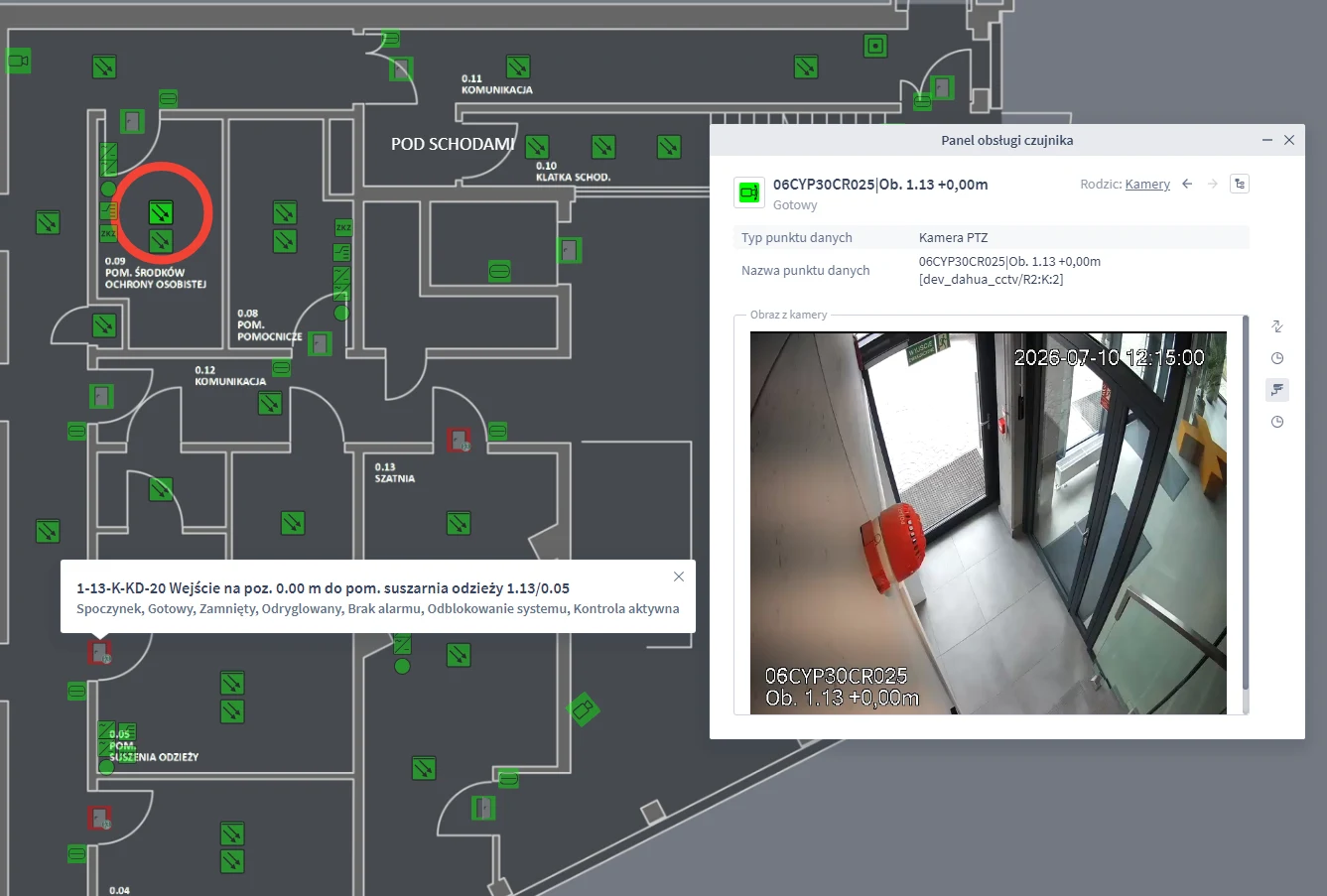
Figure 2. An example PSIM visualisation implemented on the GEMOS platform. The operator sees the location of the event, the related systems, the camera image and the response procedure.
How do PSIM, SCADA and BMS differ in practice?
Although all three systems use visualisation and alarms, their differences are most visible in two areas: the way they communicate with devices and the role of the operator.
How do SCADA, BMS and PSIM communicate with devices?
SCADA communicates primarily with programmed industrial automation controllers, and in particular with dedicated IPC (Industrial PC) computers. Communication with this type of automation uses documented and widely adopted industrial protocols that ensure data collection and response in real time. The measured values, process variables, device states and process alarms that are read out are presented on computer monitors and, in large facilities, on video walls. From within SCADA, the operator can change setpoints or the states of control devices.
BMS communicates, much like SCADA, with building automation. It most often uses PLC controllers. Communication relies on standard, open protocols such as Modbus TCP, Modbus RTU, BACnet and LON.
PSIM communicates with the control panels of the systems responsible for facility security. The timing criterion matters here too, but the permissible delays are one or two orders of magnitude greater than for a technological process. Each device usually comes from a different manufacturer and communicates in a different way, both electrically and in terms of protocol. Knowledge about data exchange in security systems is the proprietary secret of the device manufacturer, who grants PSIM vendors access to it under appropriate agreements.
How does the work of a SCADA, BMS and PSIM operator differ?
A SCADA operator should know the supervised technological process. They must understand the meaning of the parameters, the dependencies between devices and the effects of the control actions performed. In installations that run without interruption, for example in power generation, industry or pipeline operation, a SCADA workstation may be supervised around the clock.
A BMS operator is usually several people, depending on the role. In a typical use of BMS in a building, operation comes down to periodic technical inspections during which the parameters of the conditions in the building are checked, to periodic reports on energy consumption and to responding to remote notifications of a fault. If round-the-clock operation is required, it comes down to remotely notifying the technical service in the event of a fault. Increasingly, data is exchanged between BMS and PSIM — in that case the alarm response is handled by a security officer who, depending on the type of fault, notifies the appropriate technical service.
A PSIM operator works in facilities under round-the-clock protection. Their tasks include protecting the facility against intrusion by unauthorised persons or those disturbing order. Their duties also include preventing break-ins, faults, fires and vandalism — that is, taking action to prevent crimes and offences against property. The operator focuses on assessing the situation, confirming the alarm and carrying out actions in line with the procedure. In an emergency, they call the police, the fire brigade or the ambulance service. The operator’s work can be made more efficient by integrating voice communication and intercoms with the PSIM system, which makes it possible to set up the right connection without switching between separate tools. In particular situations, the operator provides first aid themselves.
PSIM, SCADA and BMS – a comparison of functions, data and applications
| Criterion | SCADA | BMS | PSIM |
|---|---|---|---|
| Main task | Supervision and control of a technological process | Supervision of a building’s installations and conditions | Handling security events and supporting the operator |
| Key question | Is the process running within the parameters? | Do the installations ensure the right conditions and reasonable utility consumption? | What happened and how should we respond? |
| Data sources | PLC, IPC, sensors and actuators | HVAC, utility meters, lifts and building automation | Fire alarm, access control, CCTV, intrusion detection, voice evacuation, intercoms and perimeter protection |
| Type of data | Measurements, trends, device states and process alarms | Measurements, trends, utility consumption and installation states | Alarms, locations, video, door states and procedures |
| Operator actions | Changing setpoints and controlling the process | Checking parameters, setpoints and handling faults | Verifying alarms, viewing cameras and executing procedures |
| Communication | Industrial automation protocols | Building automation protocols | Interfaces and protocols of security system manufacturers |
| Competencies | Knowledge of the technological process | Knowledge of operating building installations | Situation assessment and action under threat conditions |
PSIM, SCADA and BMS do not have to compete – they can complement each other
Given the fundamental differences, there is no point in replacing one system with another. BMS and PSIM in particular are complementary to each other and often occur together.
BMS supervises building installations, while PSIM can use selected data that is relevant to security.
A practical example of such cooperation is the integration of security systems in a high-rise building, covering, among other things, alarms, the location of events and information about the status and position of lifts.
PSIM can be supplied with information about:
- the power supply status,
- the operation of ventilation,
- device faults,
- the status of pumps or power generators,
- environmental parameters.
Such a combination is used, among others, in monitoring the technical infrastructure of server rooms, where a failure of the power supply, air conditioning or network devices can directly affect the security and operational continuity of the facility.
Technical data then supplements the information coming from the security systems. On this basis, the operator can assess the situation more accurately and take the right action.
Information can also flow in the opposite direction. A BMS can receive data from PSIM about the states of devices and fire protection elements.
One example is information about the closing of fire dampers in a comfort ventilation installation. Once this is passed to the BMS, for example via the Modbus protocol, the building automation can carry out an emergency shutdown of the relevant ventilation units.
The scope of such cooperation should follow from the design, the risk analysis and the operating scenarios of the installation — and, in the case of fire protection, above all from the adopted fire scenario.
Which system to choose: PSIM, SCADA or BMS?
SCADA, BMS and PSIM all use visualisation, alarms and integration, but they support different areas of a facility’s operation.
- SCADA is used to supervise and control a technological process.
- BMS performs similar functions for building installations.
- PSIM collects data from security systems and supports the operator in handling events.
These systems can exchange information and complement each other’s functions. The choice of solution should be driven by the type of problem, the competencies of the operators, the required procedures and the scope of the planned integration.
If you are wondering which system will best meet the needs of your facility, contact the ela-compil team. We will help you select the right solution and plan the scope of integration.
FAQ
- Is PSIM the same as SCADA?No. SCADA supervises a technological process and lets you influence its parameters. PSIM supports the assessment and handling of security events, using data from many connected systems.
- Where is each system used?SCADA is used in industry, power generation, water utilities and process installations. BMS supervises a building's technical installations. PSIM is used in facilities equipped with many security systems, such as access control, CCTV, fire alarm, intrusion detection, voice evacuation and perimeter protection.
- Can SCADA, BMS and PSIM work together?Yes. SCADA or BMS can pass technical information relevant to security to PSIM. Data from PSIM can also trigger actions in a BMS, provided the integration design and the agreed operating scenarios allow for it.