
In many facilities, security looks just fine. There are cameras. There are alarms. There is access control. There are procedures. There is a security station. From the perspective of management, the administrator, or the owner, everything seems to be in order.
And yet, in day-to-day operations, something keeps appearing that is invisible in system specifications or project handovers.
Security starts becoming complicated — quietly.
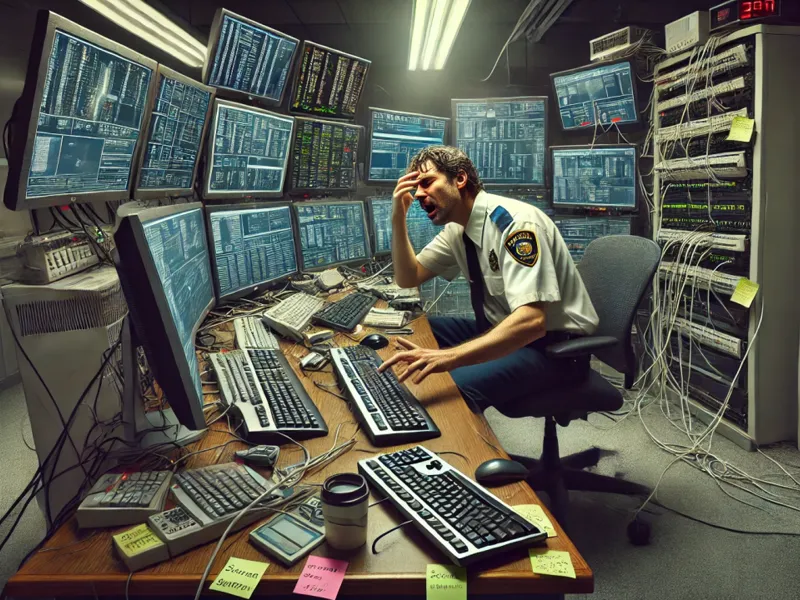
It does not happen overnight. There does not need to be a failure or a serious incident. It is enough that the security operator works across multiple screens simultaneously, receives messages from different systems, switches between applications, and each time has to piece the situation together on their own.
That is precisely when the technology meant to support begins to burden.
More systems, more capabilities — but not always greater clarity
In a modern facility, every system has its justification. CCTV, intrusion and hold-up alarm systems, access control, fire systems, intercoms, BMS, parking, elevators, building automation.
The problem is not that there are many systems.
The problem begins when each of them operates separately, communicates events differently, and requires the operator to follow a different handling logic.
In theory, the facility is secured in multiple layers.
In practice, the person at the station often does not work with a single situational picture, but rather with a collection of independent tools that must be known, remembered, and interpreted under time pressure.
And that makes an enormous difference.
The greatest burden is not always visible in reports
From the outside, everything may look correct. The alarm was acknowledged. The event was recorded. The response was carried out.
But the question is: how much effort did it cost the operator?
Did they know right away what was happening? Did they have a clear picture of the situation? Did they move from alarm to decision smoothly? Or did they first have to check several screens, confirm several pieces of information, call another person, and only then respond?
In many facilities, this additional burden becomes everyday reality. Except that over time, everyone gets used to it.
And then it begins to be treated as the norm.
It is not about people — it is about the conditions they work in
It is easy to say that more training, greater discipline, or more experienced staff are needed.
That is sometimes true. But the root cause does not always lie there.
Even a good operator will not work confidently and quickly if the working environment forces them to constantly translate technology into action.
If signals come from different places, procedures must be recalled from memory, and a complete picture of the situation only emerges after manually combining data from several systems — the problem does not lie solely with the person.
The problem lies in the fact that the security station does not give them straightforward decision support.
And that is exactly what it should be for.
The hidden cost of fragmentation
System fragmentation has its price.
It is not always an immediate error. More often, it is seconds of delay. Extra phone calls. Uncertainty. Limiting oneself to basic actions. Using only the functions that are well known. Postponing decisions until a consultation.
From the perspective of a single shift, this may seem trivial.
But from the perspective of the organization, it is a real operational cost of security.
Because security does not depend solely on which systems were purchased. It also depends on how easily a person can use them when the situation becomes ambiguous.
When technology grows faster than operational comfort
Many facilities have evolved in stages. First one system, then another, then a modernization, an expansion, a change of supplier, a new tenant, new requirements, a new procedure.
That is natural.
Except that after several years, it often turns out that the security infrastructure is already very extensive — but the operator’s workstation has not become any simpler because of it.
Quite the opposite.
The more technical layers there are, the more one thing becomes necessary: streamlining operations.
Not to add yet another window on the monitor.
But so that the person sees faster, understands more, and responds with greater confidence.
Good security should simplify, not multiply interfaces
This is the moment when many organizations begin to look at security a little differently.
Not only through the lens of devices. Not only through the lens of compliance, handovers, and system lists. But also through the question of whether the whole really works for the operator in a coherent way.
Because if technology is meant to support people, it should organize information, connect context, and guide the user through the situation — instead of forcing them to piece everything together from multiple sources on their own.
And this is exactly where the real value of an integration approach emerges.
Not as an “additional system.” Rather as a way to simplify work, organize events, and restore to the operator what they need most: situational clarity.
Security begins where the operator has clarity
In practice, the facilities that benefit the most are not those that keep adding layers of complexity endlessly, but those that begin to organize what they already have.
Where different systems start working within a single logical environment, the operator no longer has to ask themselves each time: what happened, where to check, whether it is critical, who to notify, and what to do next.
Instead of operating many separate tools, they can focus on what truly matters most: assessing the situation and responding appropriately.
And that is exactly where the conversation about security should start today.
Not with the question: what else to add? But with the question: does the current working environment truly help the operator act quickly, calmly, and appropriately?
Because if it does not — the problem is not a lack of technology. The problem is a lack of coherence.
And where the need for coherence, integration, and simpler operations arises, that is where the space opens for a modern approach to facility security management, such as that offered by PSIM-class platforms like GEMOS.