
Monday, 6:12 a.m. An alarm goes off in the delivery zone.
A new security guard is on shift. They see a message in one system, a camera image in another, the procedure in a binder, and the contact person’s number in a predecessor’s notes. They have known the facility for only a week.
They do not yet know that this alarm usually appears after the morning delivery van passes through the side gate. They do not know which camera shows that stretch of fence best. They do not know whom to call when the warehouse manager does not pick up the phone.
The minutes tick by. The technology works. The people are in place. And yet the response slows down.
The shortest version of the problem: turnover does not take away only a position. It takes away the facility’s memory.
That is exactly why security staff turnover is not solely the security company’s problem. For management it is an operational risk: unstable staffing, repeated onboarding, a higher chance of error, and the loss of knowledge that cannot easily be recreated once an experienced employee leaves.
This is not a staffing problem. It is a process problem
In many companies and institutions, security is still measured by the number of guards on a shift.
When risk rises, a post is added. When incidents occur, staffing is increased. When an audit points to weak spots, more human presence is expected.
This model is easy to understand, but increasingly hard to sustain. It assumes that the market will always supply the right number of well-prepared people. Industry data shows that this assumption is becoming more and more risky.
| Signal from the market | What it means for management |
|---|---|
| 90% of security companies described recruiting an employee as difficult or very difficult. | You cannot build security on the assumption that missing people can be replaced quickly. |
| 40% of companies reported staff turnover above 20%, and some declared levels exceeding 30%, 40% or 50%. | Turnover is not an exception. In many organisations it is becoming a permanent operating condition. |
| 63.46% of respondents pointed to client pressure to cut costs. | The market is squeezed from both sides: employees expect more, while clients want to pay less. |
| 55% of respondents see a lack of the qualifications needed to operate more advanced systems and analytics. | More technology without a simpler process can increase the operators’ overload. |
The conclusion is uncomfortable but necessary: simply adding people is no longer a strategy. More and more often it scales costs rather than security.
Why do security guards leave?
Turnover in physical security has no single cause. Money matters, but it does not explain the whole phenomenon. The decision to leave is also shaped by schedules, mental strain, the quality of support, the prestige of the role, training and work organisation.
Based on industry and pay data and on the nature of the work, the following structure of reasons for leaving can be assumed:
| Reason for leaving | Estimated share | What it tells management |
|---|---|---|
| Economic factors: pay that is too low, competition from other industries, minimum-wage pressure | 35% | Pay matters, but it is not the only lever of stability. |
| Shift work and organisational burden: nights, weekends, commutes, frequent schedule changes | 20% | Chaos in the roster quickly translates into operational chaos. |
| Quality of organisation and support: understaffing, weak support from supervisors, unclear procedures | 15% | Procedures and support influence retention almost as much as recruitment. |
| Low appeal and prestige of the profession, limited career path | 10% | The guard’s role must be more that of an operator and less passive. |
| Stress, aggression and safety risk | 10% | The less clear the response scenario, the greater the stress and the higher the risk of error. |
| Contract uncertainty and the risk of the grey economy | 5% | The choice of provider matters not only in terms of price but also of organisation. |
| Insufficient training and a competence gap | 5% | The more systems there are, the greater the need for one clear working environment. |
These figures should be treated as a cautious analytical estimate, not as the result of a single nationwide turnover survey. Their meaning is clear, however: about 35% of the reasons for leaving are tied to money, while the remaining 65% concern work organisation, stress, support, prestige and preparation for the job.
That is why changing the security company does not always solve the problem. If the model of work stays the same, turnover will return in new packaging.
The costliest loss: knowledge that is not in the documents
When an experienced security guard leaves, one person disappears from the roster. That is visible immediately.
Less visible is what leaves with them: knowledge of the layout, of typical alarms, of contact persons, of the facility’s weak points and of the informal experience gained from earlier incidents.
| What leaves with the employee | How it affects security |
|---|---|
| Knowledge of which alarms tend to be false and which require an immediate response | A new person takes longer to verify the event or reacts too late. |
| Familiarity with cameras, passages, gates, blind spots and communication shortcuts | The operator loses time searching for the right image and location. |
| Contacts for people who actually answer the phone after hours | Escalation takes longer, even though a formal contact list exists. |
| Memory of earlier incidents and how they were resolved | The organisation repeats the same mistakes during similar events. |
| The habit of acting under pressure | In a new person’s first weeks the risk of mistakes rises. |
Technology without integration can increase the chaos
Many organisations already have cameras, alarm systems, access control, technical sensors, fire protection systems, BMS or other infrastructure-monitoring tools.
The problem is that each of these systems often works on its own. It has its own screen, its own messages, its own alarming logic and its own way of being operated.
For the operator this means information overload. They have to notice the alarm, find the right camera, establish the location, check the procedure, call the right people and document the event.
The more systems there are, the greater the risk that a human becomes the manual integrator of the facility’s entire security. And a human — especially a new or overloaded one — is the weakest link in such a process.
PSIM as the facility’s operational memory
This is exactly where PSIM systems — Physical Security Information Management — come in.
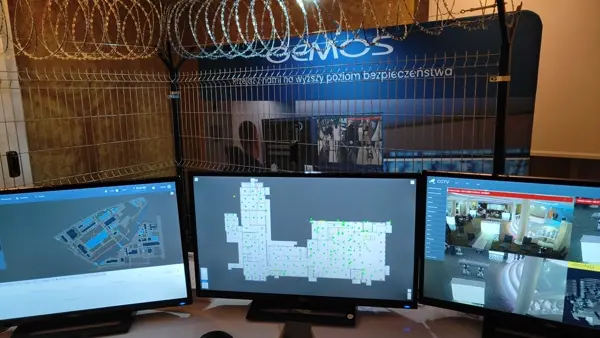
PSIM is not yet another separate technical system. It is a security-management layer that combines information from many systems, gives it context and guides the operator through the right response scenario.
A good example of this approach is GEMOS. Its role is to integrate the various security and technical systems into a single operating environment.
How does PSIM reduce the cost of turnover?
PSIM will not replace a sensible compensation policy. Nor will it solve the demographic problems of the labour market on its own. It can, however, limit the effects of turnover where they are most costly: in the quality of response, the onboarding time and the repeatability of procedures.
- A new operator understands the situation faster. The event, the location, the related alarms, the camera image and the procedure are available in one environment. The operator does not have to assemble the picture from many systems on their own.
- The procedure does not depend on one person’s memory. The system guides the employee step by step: what to check, whom to notify, when to escalate and how to document the response.
- Less chaos means less stress. A large part of the tension in security work comes from the question “what do I do now?”. A clear action scenario reduces the risk of error.
- Onboarding is shorter and more repeatable. A new person learns one working environment, not several independent applications, binders and informal instructions.
- Management gains more control over the response standard. The incident history, the way things are documented and the escalation paths stay in the system. This makes it easier to check what works and what needs to be improved.
This is not spending on “yet another system”
For management, what matters most is not what the system’s screen looks like. What matters is whether the organisation can maintain the quality of its response when the people on shift change.
If security depends mainly on the experience of a specific employee, every departure creates a gap. If part of that experience is recorded in procedures, maps, scenarios and incident history, the organisation becomes less vulnerable to turnover.
In practice, PSIM helps move from the model “a good employee remembers what to do” to the model “the process leads the employee to the right response”.
When is it worth considering PSIM?
PSIM is especially worth considering wherever security rests on many systems, many procedures and many people who have to act under time pressure.
- The facility has several independent security and technical systems.
- Operators have to switch between many screens.
- Procedures exist, but are hard to use quickly during an event.
- Turnover causes repeated training and a drop in the quality of response.
- Management wants to standardise incident handling across several locations.
- The security control room is meant to work more like a process and less like a collection of individual habits.
A hybrid model: the human decides, the system guides
The future of security does not lie in simply increasing staffing. The direction is different: less manual supervision, more integration, procedures and automation, and better use of people where their decision truly matters.
The human still makes the decisions and reacts. The system organises information, recalls procedures, documents actions and stores operational knowledge.
That is why PSIM is not spending on yet another technology. It is an investment in the stability of the security process. And where security staff turnover has become an everyday reality, the stability of the process is one of the most important management values.
See how GEMOS keeps the response standard steady despite turnover
If turnover has become an everyday reality in your facility, see how GEMOS helps move procedures, maps and response scenarios out of individual people’s heads and into a single security-management environment.
Fill in the contact form and arrange a demo. We will show how a new operator can work to the same standard as an experienced employee — even in their first days on the job.
Data sources: the PZPO report “The Security Industry in Poland 2025”, the PZPO security industry report 2022/2023, the Barometr Zawodów 2025 (Occupational Barometer) and Polish Police data on qualified physical security guards.
FAQ
- Is security staff turnover only the security company's problem?No. For the facility manager it is first and foremost an operational risk — every departure of an experienced person means a loss of knowledge about the building and a decline in the quality of incident response.
- Does a PSIM system reduce security staff turnover?PSIM will not replace a sensible compensation policy, nor will it solve the demographic problems of the labour market. It can, however, lower the cost of turnover that cannot be avoided — it shortens onboarding and keeps procedures repeatable despite changes in staffing.
- What exactly does an organisation lose when an experienced operator leaves?Knowledge of the building's layout, of recurring alarms, of current contacts and of the history of earlier incidents. PSIM moves part of this knowledge out of people's heads and into maps, procedures and response scenarios.