
In many facilities, security technology developed in stages. First came CCTV, then intrusion detection, followed by fire alarm systems, building automation, additional operator workstations, and more applications. Each system works correctly within its own scope, but from the perspective of the operator and facility manager, they often form separate worlds.
That is precisely where the conversation about PSIM begins.
What Is PSIM?
PSIM stands for Physical Security Information Management. In practice, it is a software platform designed to connect different security systems and technical data sources into a single shared management environment.
Simply put: PSIM does not replace all the devices in a facility. Instead, it brings them together, organizes the information, and helps people make the right decisions faster.
As a result, operators no longer need to watch multiple independent screens, switch between applications, or piece together facts under time pressure. The PSIM system collects data from various sources, correlates it, and presents it in the logical context of an event.
Why Having Multiple Systems Is Not Enough
The fact that a facility has modern equipment does not yet mean it operates in an integrated way. In practice, the problem very often lies not in a lack of technology, but in a lack of unified management.
Typical symptoms of this situation include:
- an alarm appears in one system, while the camera view must be located manually,
- the operator sees a signal but has no clear procedure to follow,
- information from different installations does not form a single picture of the situation,
- the response depends more on the experience of a particular person than on an organized process,
- after an incident, it is difficult to reconstruct the full sequence of events and assess what worked and what did not.
That is precisely why more and more facilities are no longer looking for another standalone system, but for a solution that ties everything together operationally.
How Does a PSIM System Work?
A PSIM system operates as an integration and operational layer on top of the existing infrastructure. It connects to various subsystems, receives events from them, interprets dependencies, and presents the operator with ready-made context.
In practice, this means several key functions.
1. Multi-environment Integration
PSIM can collect information from areas such as:
- video surveillance,
- intrusion and hold-up detection systems,
- fire detection systems and fire-fighting equipment,
- building automation,
- public address and voice alarm systems,
- other technical installations and data sources relevant to facility security.
The key point is that operators no longer see separate silos — they see one coherent picture of the situation.
2. Event Correlation
PSIM does not stop at displaying an alarm. Its value lies in its ability to link information from multiple sources.
When an event occurs in a facility, the system can automatically:
- display the appropriate camera view,
- indicate the exact location on a map or floor plan,
- trigger the relevant response procedure,
- present the operator with step-by-step instructions,
- log the full event trail for later analysis.
This is the fundamental difference between simply receiving signals and actually managing a situation.
3. Step-by-Step SOP Procedures
In a well-implemented PSIM environment, the operator is never left alone with the question “what now?” The system can guide them through pre-defined standard operating procedures (SOPs).
This is especially important where:
- staffing changes frequently,
- time pressure is high,
- not every situation occurs regularly,
- compliance with organizational procedures is required.
As a result, the response does not depend solely on the memory and experience of a single employee.
4. Visualization and Situational Awareness
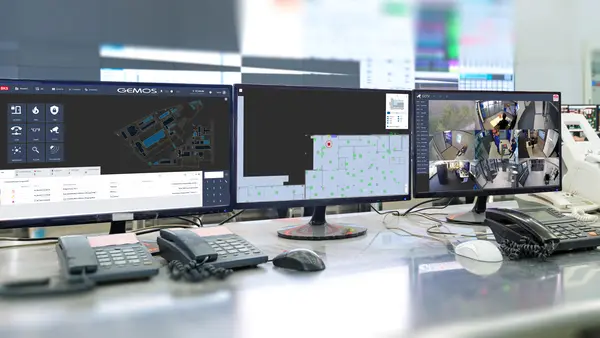
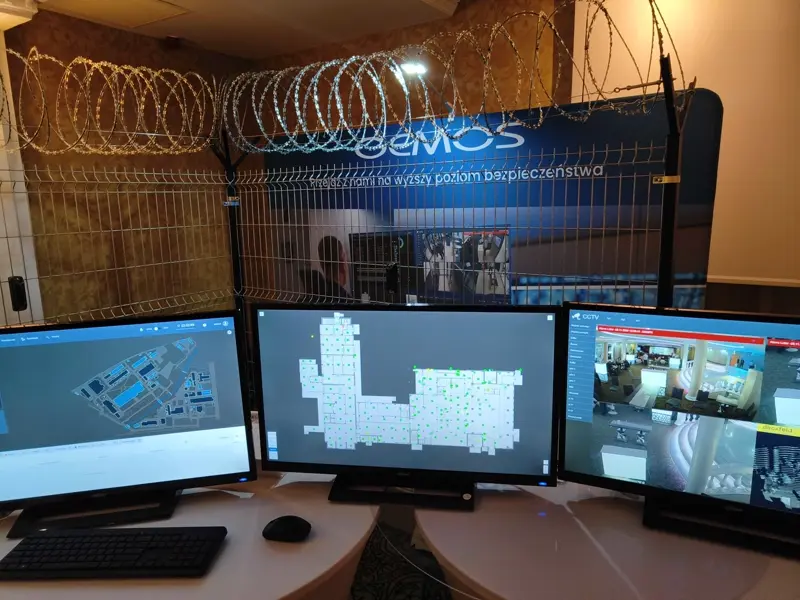
One of the greatest advantages of PSIM is the ability to present events on floor plans, maps, and interfaces that show the relationships between systems.
Instead of reading through a list of messages, the operator sees:
- exactly where an event occurred,
- which devices are associated with it,
- what actions have been triggered,
- the current status of the situation.
This is what builds situational awareness — without it, even the best equipment may fail to deliver the expected operational outcome.
How Does PSIM Differ from VMS or Single-Domain Platforms?
This is one of the most common questions.
A VMS focuses primarily on managing camera footage. Other domain-specific platforms typically concentrate on their own functional area. PSIM operates more broadly.
PSIM is not just an observation tool. It is a platform for coordinating events, procedures, and responses.
This means its purpose is not only to present data, but also to:
- connect information from multiple systems,
- give that information shared meaning,
- support the operator in taking action,
- document the handling of each incident.
What Are the Benefits of Implementing PSIM?
Shorter Response Times
When the system automatically correlates an alarm with the camera view, location, and procedure, the operator does not waste time searching for information manually. In critical situations, seconds truly matter.
Fewer Human Errors
The more applications, screens, and ambiguous alerts there are, the greater the risk of mistakes. PSIM brings order to that chaos and reduces reliance on improvisation.
A Single Place to Manage Security
For operators, security managers, and facility administrators alike, the ability to bring all information into a single environment is enormously valuable. It simplifies day-to-day work and makes oversight easier.
Better Post-Incident Analysis
PSIM logs events, operator responses, and completed steps. This makes it possible to evaluate not only what happened, but also how well the organization responded.
Greater Technological Flexibility
A well-designed PSIM platform allows a security environment to grow without locking the organization into a single equipment vendor. This matters wherever the system needs to live and evolve over many years.
Lower Operator Onboarding Cost
High turnover among security personnel is a common challenge. The risk is the loss of institutional operational knowledge. Training staff to use a single, intuitive interface instead of several different systems delivers significant savings.
Is PSIM the Right Solution for Every Facility?
Not every facility needs a full PSIM platform. If the infrastructure is small and the number of scenarios is limited, a conventional approach may be sufficient.
PSIM becomes particularly justified when a facility has:
- many systems running in parallel,
- an extensive technical infrastructure,
- high continuity-of-operations requirements,
- a need to guide operators through defined procedures,
- a need to centralize security management,
- multiple sites or several layers of supervision.
This solution is particularly well suited to facilities that are complex, large in scale, and demand a high quality of operational response.
GEMOS as an Example of Modern PSIM

A good example of a PSIM-class platform is GEMOS. This is an environment whose strength lies not in any single feature, but in its ability to integrate multiple areas of security and building technology into one coherent management system.
In practice, GEMOS makes it possible to build an environment in which:
- different systems feed data into a single platform,
- the operator works within a single interface,
- events are presented in situational context,
- response procedures can be standardized,
- the facility is served not by a collection of separate tools, but by one logically organized ecosystem.
From the user’s perspective, what matters most is not that the system “has integration,” but that it genuinely makes security management easier.
What to Look for When Choosing a PSIM System?
When evaluating a PSIM platform, it is worth looking beyond the number of possible integrations. Equally important are practical questions:
- does the system genuinely organize the operator’s work,
- does it allow response scenarios to be defined,
- does it allow the solution to scale over time,
- does it support redundancy and high availability,
- does it make reporting and event analysis easier,
- does the integration translate into a real improvement in how work is organized, rather than just a demo effect.
Because the true value of PSIM lies not in the fact that “everything can be connected,” but in the fact that the whole begins to function as a single organism.
Summary: What Is PSIM?
To answer in one sentence:
PSIM is a platform that connects distributed security systems and technical data sources into a single management environment — one that supports faster decisions, better coordination, and greater predictability in operator actions.
For a modern facility, PSIM is not a trendy add-on. It is increasingly the answer to a very specific problem: the technology exists in the building, but without a shared operational logic, it does not deliver full situational control.
And that logic is precisely what a well-implemented PSIM system is designed to provide.